 |
Catalyst Communications Technologies, Inc. provides mission critical dispatch solutions for public safety, government, utility, energy, and commercial markets throughout the United States and Canada. Our Radio over IP solutions are used for primary, back-up, and mobile dispatch and interoperability. Our preferred implementation in DMR radio systems is through our standards compliant AIS Wireline Interface which offers advanced control of radios through the DMR infrastructure, and we operate on Tier II networks through the RF interface using various control stations.
Products and Information
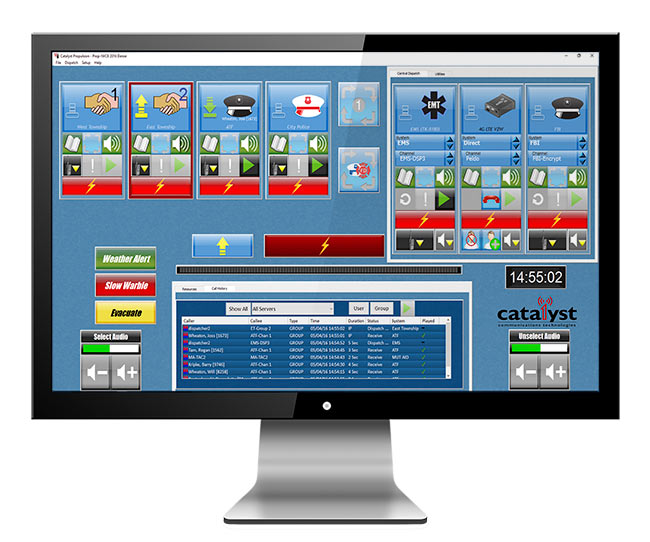
Consoles - Propulsion™ is an advanced, full-featured Radio Control over IP (RCoIP) dispatch system designed to meet the stringent reliability requirements of Public Safety, Utility, and Government dispatch applications. When deployed as part of a DMR system, Propulsion supports the Application Interface Specification (AIS) for Tier III systems and the RF interface using various control stations for Tier II systems.
One of Catalyst’s strengths is our technology – it supports advanced control of different radio systems, and it maximizes interoperable communications in multi-agency and multivendor environments. Propulsion™ solutions support radio systems from most manufacturers and a multitude of radio system technologies such as Project 25 (P25), EDACS, DMR, NXDN, and Tone Control Interfaces. For P25, Propulsion™ supports the Console Sub-System Interface (CSSI), the Fixed Station Interface (FSI), and various control stations using the Common Air Interface (CAI). Propulsion also supports new Mission Critical Push-To-Talk over Broadband / LTE, connecting to 3GPP-compliant services including FirstNet® Built with AT&T and Southern Linc’s CriticalLinc™, as well as proprietary push-to-talk systems through our CSSI interface. This multi-vendor support facilitates a seamless migration to DMR from legacy radio networks.
Brochure |
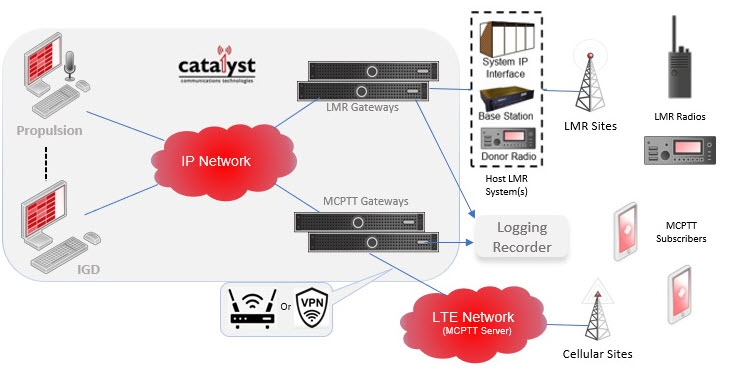
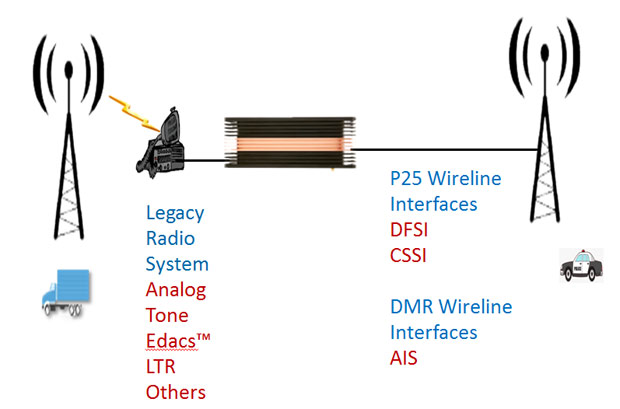
Interoperability – The IntelliLink™ Gateway from Catalyst Communications Technologies links multiple talk groups or channels between different Land Mobile Radio and/or Broadband Mission Critical Push-to-Talk systems including DMR, Project 25, LTR, analog conventional, and others. For legacy radio systems striving to migrate to DMR, this result is accomplished through advanced gateway connections between legacy mobile radios that have RF linkage to the Legacy radio system and a wireline Application Interface Specification (AIS) connection to the DMR Tier III system.
One example that demonstrates how IntelliLink™ Gateway is superior to other solutions is that we manage the flow of audio between two radio systems to guard against lost audio.
Brochure |
Catalyst provides an advanced interface to the legacy radios, the DMR Tier III System, P25, and MCPTT over broadband / LTE. When talk groups on the two systems are patched together using the IntelliLink™ Gateway, Catalyst buffers the audio until the target radio system is ready to re-transmit it so that the complete transmission is routed between these systems and DMR. Rather than VOX, Catalyst uses the digital message from each system, when available, to know when each call starts and stops, creating a more reliable and faster interoperability solution.
The IntelliLink™ Gateway also creates a visual record of every call to and from both systems so that the System Administrator can review the call flow after an incident. The IntelliLink™ Gateway does not require the use of a Catalyst Propulsion™ Dispatch Console and may be used by agencies that either do not need a console or already have a console from a different manufacturer.
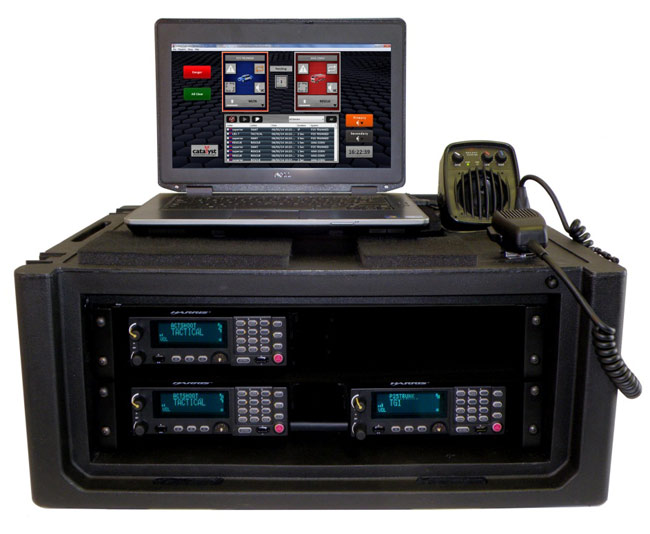
Transportable Solutions - Incident Commander Element (ICE™) is a transportable command and control solution that provides enhanced graphics and control for radio voice communications across multiple frequency bands and multiple types of radio systems including Project 25, DMR, and conventional Land Mobile Radio and Mission Critical Push-to-Talk over broadband / LTE. ICE™ provides essential information for fire ground, emergency medical, special rescues, utility restoration, and other public safety and critical infrastructure incidents.
A single computer controls up to four mobile radios and provides the control and user interface. Dispatch can be operated in stand-alone mode or linked back to the agency’s normal radio system and to other radio channels as needed. This rugged, compact, and efficient solution can be purchased in a robust travel case or installed in a vehicle.
Brochure |